


Success Story
Cursor powered by OEX
Multi-Brand WordPress Platform for an Outsourcing Group: Three Sites Built From One Shared Architecture
About
Warsaw-based sales outsourcing company and part of OEX Group - needed to launch three rebranded websites simultaneously while keeping long-term editorial costs low.


Summary
Cursor powered by OEX needed to launch three rebranded websites for three legally distinct companies - Cursor, ProPeople, and MerService - all managed by a single marketing teamwithout rebuilding each site from scratch.
The previous CMS was so restrictive that the marketing team had stopped using the website as a channel entirely - any content change required a developer.
Fooz delivered a shared parent-child WordPress architecture that restored full editorial independence to the marketing team, launched child themes in a fraction of the primary build time, and drove ~30% growth in inbound leads within months - without any new paid campaigns.
Context & Challenge
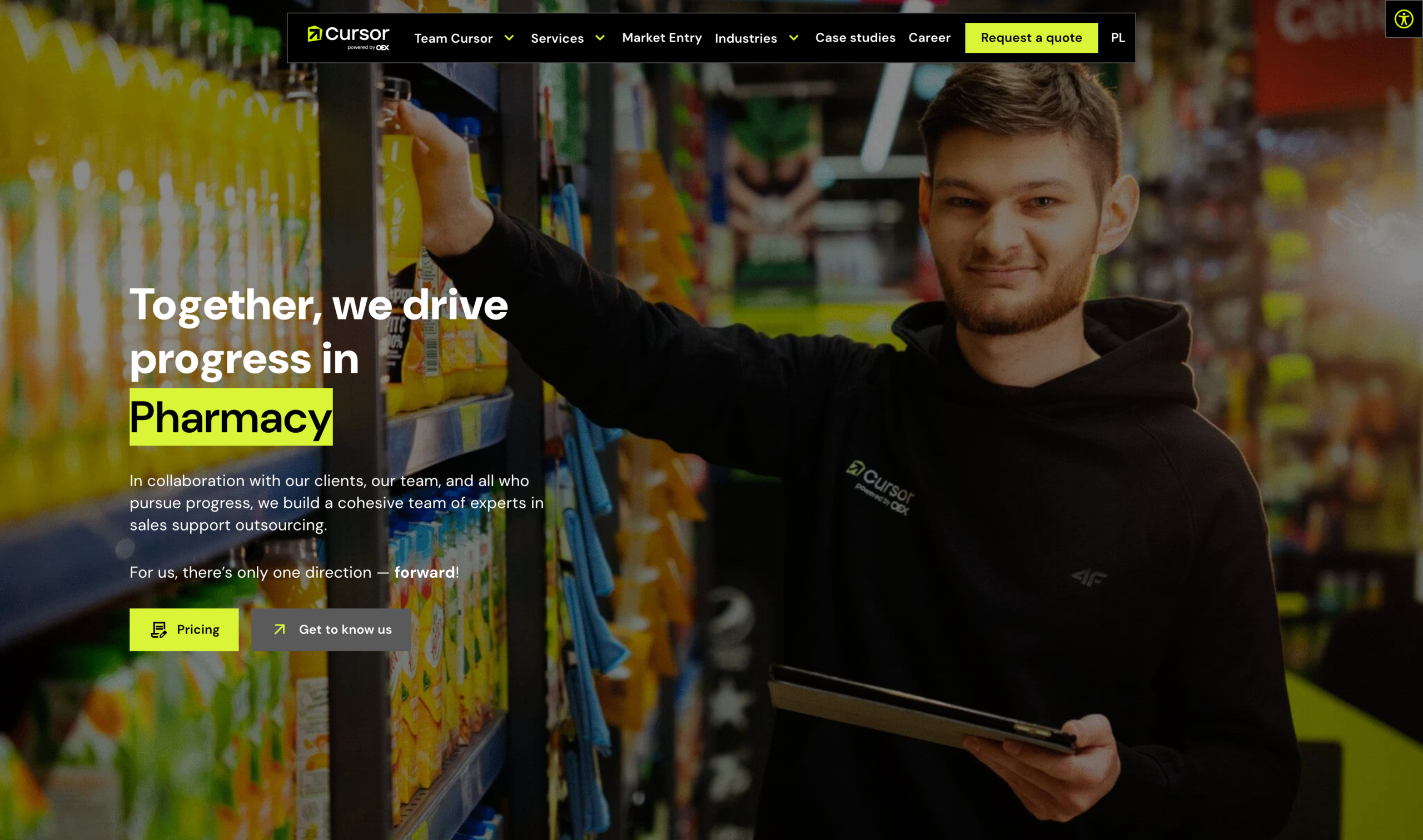
Cursor is the partner of choice supporting the sales of global brands in Poland, , operating as part of OEX Group, a Warsaw-based holding company with over a dozen subsidiaries. The company's marketing function covers three brands simultaneously - Cursor, ProPeople (HR & payroll management), and MerService (sales support experts for FMCG brands)
The trigger for the project was a group-level rebranding decision: all OEX subsidiaries were required to align with a new brand framework, including a defined color palette, approved typefaces, and mandatory group endorsement elements such as a "Powered by OEX" logo variant and “Growth System” footer marks. But the underlying problem ran deeper than aesthetics. The previous CMS was so restrictive that the marketing team had effectively stopped treating the website as a marketing channel - landing pages couldn't be created without developer involvement, and even minor content updates required routing through external contractors. As one stakeholder put it:
As one stakeholder put it:
The site effectively didn't exist as a marketing tool. Now it's become the central axis of our marketing operations.

Head of Marketing, Marketing Director, Cursor powered by OEX
A secondary problem was infrastructure fragmentation. Three separate websites lived on different hosting providers, managed by different developers, with domains registered in different places. Monthly administrative overhead was significant, and knowing who was responsible for what required asking from scratch each time.
Approach & Delivery
Architecture & design
The central architectural decision was to build a single parent WordPress theme with a shared Gutenberg block library, from which ProPeople and MerService would inherit via child themes. This was the right call for a constrained budget and a tight launch timeline - but it required close coordination between design and development from the first sprint.
The designer, Filip, was briefed to create components with cross-brand reuse in mind: flexible enough to serve different layouts across three distinct brand identities, but consistent enough to avoid duplicating development effort.
A module used to display team photos on the Cursor site, for example, was repurposed to display client logos on MerService - the same underlying block, different content strategy.

Development
The deployment infrastructure was built around a single repository with a shared main branch that deploys simultaneously to all three sites. Each brand has its own branch for brand-specific overrides, so a global improvement - a performance fix or a block update - propagates automatically without requiring separate deployments.
This structure also solved the administrative fragmentation: all three sites now run under a single hosting and DNS setup, with one point of contact for infrastructure.

Migration
Migration required deliberate content triage rather than a full transfer. The previous site carried years of low-value pages - duplicate category structures, single-paragraph news items about executive changes from half a decade ago, and inconsistent URL patterns.
Working alongside the client's SEO agency, Fooz audited existing content, consolidated duplicate posts, standardized internal link structures, and mapped redirects before the migration began.
The goal was to protect ranking equity while simultaneously cleaning up technical debt that had accumulated over years of unmanaged publishing.
Translations
The English-language version of the Cursor site was handled through Fooz's own Fooz Live Translate integration, powered by DeepL.
Automated translation covered the full site, with the client's team performing a post-translation review pass to correct domain-specific terminology - an efficient division of labor that avoided the cost of manual translation at scale.
Cross-platform reusable elements
Tech Stack
 CMS
CMSWordPress (custom parent theme + child themes)
Content management for three brand sites from a single codebase
 Page builder
Gutenberg (custom blocks)
Editorial interface - structured block library enabling independent content publishing
 Deployment
Single Git repository with brand-specific branches
Simultaneous multi-site deployment; per-brand overrides without code duplication
 Translation
Fooz Live Translate
Automated EN translation of the full Cursor site with human review layer
 Recruitment integration
Third-party recruiter system (API integration)
Dynamic job listing sync across multiple OEX entities with per-brand display rules
 CRM forms
Custom WordPress forms (1:1 migration from legacy)
Preserved existing CRM field mapping for lead routing
 User access
Custom Protected Editor role (WordPress)
Restricted editorial access for non-marketing users (e.g. reporting team, HR)
 Hosting
Siteground
Unified infrastructure and invoicing across all three sites
 Analytics
Google Tag Manager
Structured event and conversion tracking - [VERIFY specific setup post-migration]
Results

Before
- Three separate sites on different hosting providers, managed by different developers - no single point of contact
- CMS so restrictive that the marketing team had stopped using the site as a marketing tool
- Any content change required routing through an external developer or contractor
- Infrastructure fragmented across uncoordinated DNS, hosting, and billing setups

After
- Single unified platform: one codebase, one deployment pipeline, one hosting vendor
- Marketing team publishes landing pages, reports, and premium content independently - no developer required
- Non-marketing staff (reporting team, HR) operate within scoped Protected Editor roles
- Inbound leads up ~30% within months of launch, with no new paid campaigns running

Metrics & Values
Post-launch, the client also reported external feedback - including from prospects in first sales meetings - specifically noting the quality of the Cursor site.
If I bring in a new team member who's never worked in WordPress before, they can go in and get it right 80% of the time - without any training.
Head of Marketing, Head of Marketing, OEX Cursor / ProPeople / MerServicee

Project Timeline

architecture
~1 month

~1 weeks

~3 months

~2 months

~2 weeks
ProPeople and MerService child theme builds ran partially in parallel with Cursor development and QA, rather than strictly sequentially.

Summary
Key Lessons
Planning a multi-brand WordPress system for a group or holding company?
We've done this before - shared architecture, brand-specific child themes, unified deployment, and editorial systems that non-technical teams can actually use. If you're managing websites for two or more related entities and spending too much time on coordination overhead,